
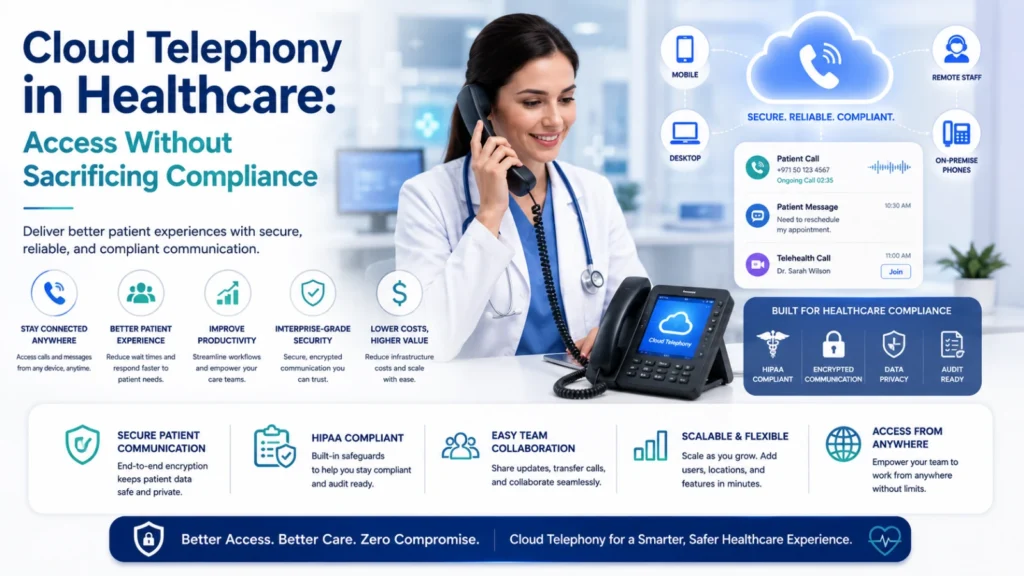
Healthcare providers face constant calls: appointments, prescriptions, results, and urgent questions. Patients expect quick access, but sensitive health information demands real protection. These two needs can feel like they’re pulling in opposite directions. Cloud telephony exists to satisfy both at once.
Why Healthcare Call Volume Is Especially High
Clinics and hospitals field calls for appointments, refills, and general questions constantly. Administrative staff often spend more time on calls than direct patient care. A missed call can mean a delayed diagnosis or missed treatment step. Unlike many industries, delays here carry real, personal consequences.
The Real Tension Between Access and Compliance
Patients want fast answers, ideally without long holds or repeated transfers. At the same time, health information requires strict handling and limited access. Systems built purely for speed can accidentally expose sensitive information. Systems built purely for compliance often become slow and frustrating to use.
How Cloud Telephony Improves Access First
Cloud systems route calls automatically to the right department or available staff. Virtual receptionists can handle appointment scheduling outside normal clinic hours. Patients get faster responses without needing more front-desk staff. This reduces wait times without requiring a complete staffing overhaul.
Virtual Agents Handle Routine Requests Safely
Many healthcare calls are routine: booking, rescheduling, or basic information requests. Virtual agents can handle these without needing access to full medical records. Complex or sensitive calls still get escalated to trained staff directly. This keeps routine efficiency separate from sensitive clinical decisions.
Access Controls Keep Sensitive Data Properly Restricted
Not every staff member needs access to every patient’s full call history. Cloud systems support role-based access, limiting who can view specific data. This reduces the risk of unnecessary exposure to sensitive health information. Proper access control is a foundational, not optional, compliance requirement.
Call Recording Requires Careful, Transparent Handling
Recording calls can support quality assurance and accurate documentation. In healthcare, this must be handled with explicit patient consent and disclosure. Recordings should be stored securely, with clear rules on who can access them. Done properly, recording supports both accountability and patient trust.
Encryption Protects Information in Transit and at Rest
Health-related calls and data should be encrypted during transmission and storage. This protects against interception and unauthorized access significantly. Reputable cloud telephony providers build this protection in by default. Businesses should confirm this explicitly before choosing any provider.
Integration With Patient Records Adds Real Value Carefully
Connecting phone systems with patient record systems improves continuity of care. Staff can see relevant context without digging through separate systems manually. This integration must still respect the same access and privacy controls. Convenience should never come at the cost of proper data protection.
Multilingual Support Improves Real Access for Patients
Healthcare providers often serve patients speaking multiple different languages. Cloud systems can route calls based on language needs automatically. This genuinely improves access for patients who might otherwise struggle to communicate. Real accessibility includes language, not just faster phone lines.
The Bottom Line
Healthcare doesn’t have to choose between fast access and strict compliance. Cloud telephony, implemented properly, supports both requirements simultaneously. Routing, virtual agents, and multilingual support improve patient access directly. Access controls, encryption, and consent handling protect sensitive information just as seriously.
Frequently Asked Questions
Can healthcare providers legally use cloud-based phone systems?
Yes, when providers follow applicable data protection and privacy regulations. Always confirm compliance requirements specific to your region.
Does call recording violate patient privacy automatically?
Not if handled properly, with clear consent and secure storage. Improper handling, not recording itself, creates real risk.
How does cloud telephony reduce patient wait times?
Automatic routing and virtual agents handle requests faster than manual processes. This reduces delays without requiring more staff.
Can virtual agents access sensitive medical information?
Well-designed systems limit virtual agents to routine, non-sensitive tasks only. Sensitive requests get escalated to trained human staff.
Is role-based access control difficult to set up?
Most modern cloud telephony platforms support this as a standard feature. Proper configuration still requires careful initial planning.
Does multilingual support really improve healthcare access?
Yes. Patients who struggle with language often face real communication barriers. Language-based routing directly addresses this gap.


