
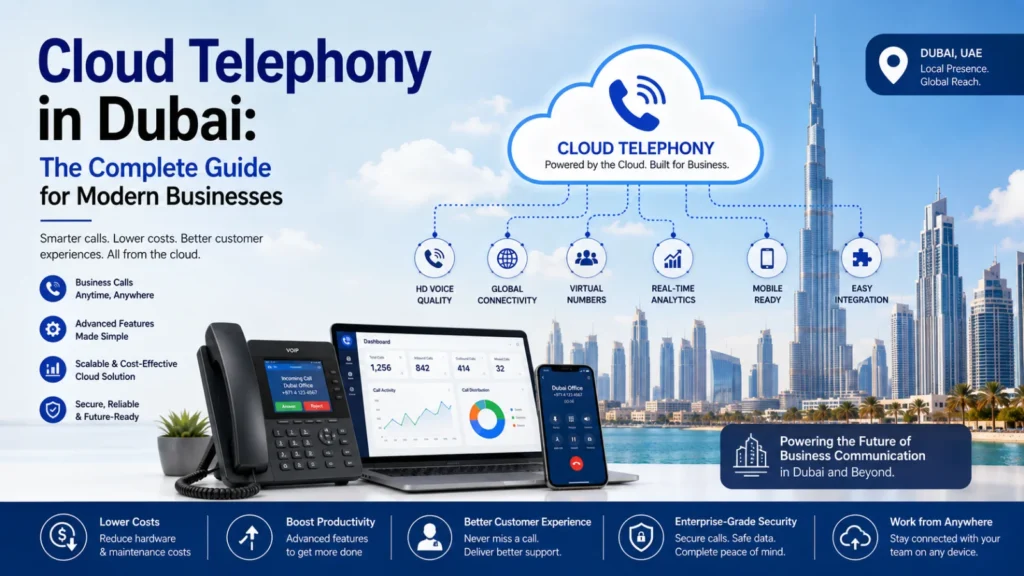
Dubai’s business landscape moves fast. Companies here compete on speed, service, and scale. Traditional phone systems can’t keep up anymore. That’s why more Dubai businesses are switching to cloud telephony. This guide explains what it is, why it matters, and how to choose the right solution.
What Is Cloud Telephony?
Cloud telephony replaces physical phone hardware with internet-based calling. Instead of copper wires and PBX boxes, calls travel over the internet. Your phone system lives in the cloud, not a server room. This is often called VoIP, or Voice over Internet Protocol. Employees can make and receive calls from anywhere. All they need is an internet connection and a device. No wiring, no bulky equipment, no maintenance headaches.
For Dubai businesses, this flexibility is a game-changer. Teams often work across multiple offices or remotely. Cloud telephony connects everyone under one unified phone system. It also scales instantly as your team grows.
Why Dubai Businesses Are Making the Switch
1. Lower Costs, Higher Value
Traditional phone lines are expensive to install and maintain. Cloud telephony cuts hardware costs dramatically. There’s no need for expensive PBX equipment or dedicated phone lines. International calls also become far cheaper. For a business with global clients, this adds up fast. Most providers offer flexible monthly plans too. You pay only for what you actually use.
2. Seamless Remote and Hybrid Work
Dubai’s workforce is increasingly distributed. Employees might work from home, a branch office, or while traveling. Cloud telephony makes location irrelevant. A call to your Dubai office number can ring on a laptop in London. Your team stays connected no matter where they are. This supports Dubai’s growing hybrid work culture perfectly.
3. Professional Image, Local Presence
Many international companies want a local Dubai number. Cloud telephony makes this simple and affordable. You can get a local number without opening a physical office. This builds trust with local customers immediately. It also signals that you’re serious about the UAE market.
4. Smart Features That Traditional Lines Can’t Match
Cloud telephony isn’t just about making calls. It includes call recording, voicemail-to-email, and auto-attendants. Interactive voice response, or IVR, routes callers automatically. Call analytics show you patterns in customer behavior. Integration with CRM tools means every call gets logged. Your sales and support teams work more efficiently as a result.
5. Built-In Scalability
Growing businesses need systems that grow with them. Adding a new employee is as simple as creating an extension. There’s no need to install new lines or hardware. This makes cloud telephony ideal for Dubai’s fast-scaling startups. It’s equally useful for established enterprises expanding into new markets.
6. Disaster Recovery and Reliability
Physical phone systems fail during power outages or hardware issues. Cloud telephony runs on redundant, distributed servers. If one data center goes down, another takes over. Calls can automatically reroute to mobile phones during outages. This keeps your business reachable during emergencies. For customer-facing companies, this reliability is essential.
7. Better Customer Experience
Customers expect quick, professional responses today. Cloud telephony reduces hold times through smart call routing. Calls reach the right department or agent immediately. Missed-call alerts and callback options keep customers engaged. Happy customers are more likely to return and recommend your business.
8. Unified, Multi-Channel Communication
Modern cloud systems combine voice, SMS, and even video calling. Everything runs through one platform instead of scattered tools. Agents can switch between channels without losing context. This creates a smoother experience for both staff and customers. It also simplifies reporting across every communication channel.
Cloud Telephony vs. Traditional PBX
Understanding the difference helps clarify why the shift matters. Traditional PBX systems rely on physical hardware installed on-site. They require dedicated phone lines and ongoing maintenance contracts. Upgrades often mean replacing entire units at high cost. Cloud telephony, by contrast, lives entirely online. Updates happen automatically, without technicians visiting your office. Adding or removing users takes minutes, not weeks. Traditional PBX also ties your phone system to one location. Cloud telephony frees your team to work from anywhere. For a city as mobile and international as Dubai, this matters enormously. Businesses that switch often report faster setup and lower total costs.
Common Myths About Cloud Telephony
Some business owners still hesitate due to misconceptions. Let’s clear up a few common ones.
Myth: Cloud telephony has poor call quality. Modern systems use high-quality codecs and prioritized bandwidth. Call quality often matches or beats traditional lines.
Myth: It’s only for large companies. Small businesses benefit just as much, often more. Flexible pricing means you only pay for what you need.
Myth: Switching is complicated and slow. Most providers handle migration and number porting for you. Many businesses are fully operational within days.
Myth: It’s not secure. Reputable providers use strong encryption and strict compliance standards. Security is often stronger than outdated on-site systems.
Cloud Telephony and UAE Regulations
The UAE regulates telecommunications through the Telecommunications and Digital Government Regulatory Authority, known as TDRA. Business VoIP and cloud telephony services must come from licensed providers. This differs from free consumer apps, which face restrictions in the UAE. Always choose a provider that is properly licensed and compliant. This ensures your business avoids service disruptions or legal issues. A reputable provider will be transparent about their licensing status.
Industries in Dubai Benefiting Most
Real Estate
Agents juggle constant calls from buyers, sellers, and tenants. Cloud telephony logs every call and integrates with property CRMs. Nothing falls through the cracks.
E-Commerce and Retail
Customer support volume can spike unpredictably. Cloud systems scale up instantly during sales events or promotions. Queue management keeps customers from waiting too long.
Call Centers and Customer Support
Multiple agents can share numbers and queues seamlessly. Supervisors monitor calls in real time for quality control. Reporting tools highlight where training is needed most.
Financial and Professional Services
Call recording supports compliance and dispute resolution. Secure, encrypted calls protect sensitive client information. Professional IVR menus improve the client experience from the first call.
Hospitality and Tourism
Hotels and tour operators handle bookings from around the world. Cloud telephony supports multiple languages and international numbers easily. Guests get quick, professional responses no matter the time zone.
Healthcare and Clinics
Clinics manage constant appointment calls and patient inquiries. Cloud systems route calls to the right department instantly. Call recording also helps maintain accurate patient communication records.
Cloud Telephony Trends Shaping Dubai in 2026
Dubai continues to position itself as a global business hub. Digital transformation initiatives push companies toward cloud-first technology. Artificial intelligence is increasingly built into cloud telephony platforms. AI-powered call summaries and sentiment analysis are becoming standard features. Businesses use these insights to improve service quality quickly. Integration with WhatsApp Business and other messaging apps is also growing. Customers expect to reach companies through their preferred channel. Cloud telephony providers that support this flexibility stand out. As remote and hybrid work remain common, demand keeps rising. Companies that adopt cloud telephony early gain a competitive edge.
How to Choose a Cloud Telephony Provider in Dubai
Not all providers are equal. Here’s what to look for.
- Local licensing. Confirm the provider is compliant with UAE telecom regulations.
- Call quality. Ask about uptime guarantees and network reliability.
- Integration options. Check compatibility with your existing CRM and helpdesk tools.
- Scalability. Make sure the platform can grow alongside your business.
- Support. Look for responsive local customer service, ideally in your time zone.
- Security. Verify encryption standards and data protection practices.
- Pricing transparency. Avoid providers with hidden fees or confusing contracts.
Take time to compare a few providers before committing. Request a demo or trial period whenever possible. This helps you test call quality firsthand.
Getting Started
Switching to cloud telephony doesn’t have to be disruptive. Most providers offer number porting, so you keep your existing number. Setup can often be completed within days, not weeks. Training your team usually takes just a short session. Many businesses see immediate improvements in call handling and customer satisfaction.
A typical onboarding process follows a simple path. First, you choose a plan based on your team size. Next, the provider ports your existing numbers over. Then your team receives short training on the new system. Finally, you test call quality and routing before going fully live. Most businesses complete this entire process within one to two weeks.
If your Dubai business still relies on outdated phone systems, now is the time to modernize. VOYCELL can help you make the transition smoothly. Reach out today to explore a cloud telephony solution built for your needs.
Frequently Asked Questions
Is cloud telephony legal in Dubai?
Yes, as long as it’s provided by a licensed telecom operator. The TDRA regulates all business VoIP services in the UAE.
How is cloud telephony different from a traditional phone system?
Traditional systems use physical wires and on-site hardware. Cloud telephony runs entirely over the internet, with no hardware required.
Can I keep my existing business number?
In most cases, yes. Providers typically support number porting to your new cloud system.
Is cloud telephony secure for sensitive business calls?
Reputable providers use strong encryption and comply with data protection standards. Always verify a provider’s security certifications before signing up.
How much does cloud telephony cost in Dubai?
Costs vary based on features, number of users, and call volume. Most providers offer flexible monthly plans instead of large upfront investments.
How long does setup take?
Many businesses go live within a few days. Complex, multi-location setups may take slightly longer.
Can remote employees use the same phone system?
Yes. Employees can make and receive calls from any location with internet access.
What happens if the internet goes down?
Most providers offer automatic call forwarding to mobile numbers. This keeps your business reachable even during outages.
Do I need special hardware?
No special hardware is required. Calls can be made through apps, softphones, or existing devices.
Is cloud telephony suitable for small businesses?
Yes. It’s often more affordable and flexible than traditional systems, making it ideal for small and growing teams.


