
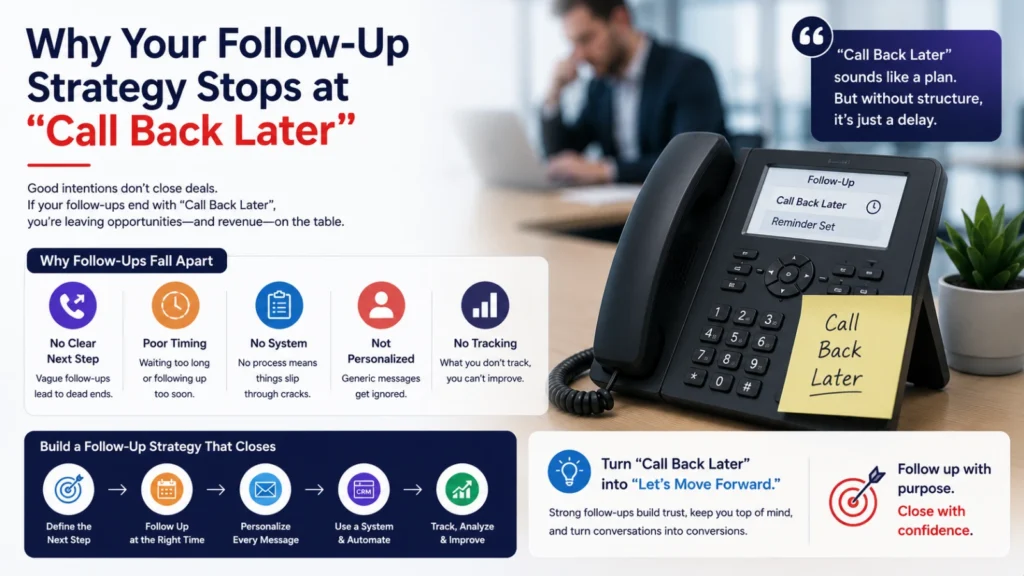
“Call back later” is the most common status in B2B CRMs. It sounds harmless, almost polite. In practice, it’s often where good leads quietly disappear. Here’s why that happens, and what actually fixes it.
"Call Back Later" Isn't Really an Answer
When a prospect says this, they’re often just ending the call politely. It rarely means they’re genuinely interested and simply busy right now. Sales reps log it anyway, because it feels better than “not interested.” That single vague label then becomes the entire follow-up plan.
The Problem With Treating It as a Status
Most CRMs treat “call back later” as one generic bucket. It gives no sense of timing, urgency, or actual objection. A rep calling back has no real context to work from. They end up repeating the same pitch, hoping something lands differently. Unsurprisingly, that approach converts at a very low rate.
Why Generic Follow-Ups Fail Twice
The first call didn’t land because something specific held the prospect back. Maybe it was timing, budget, or simply not being ready yet. A generic follow-up call ignores that specific reason entirely. It essentially restarts the conversation from zero, wasting everyone’s time. Prospects notice this, and it damages trust in the process.
What Should Happen Instead of a Vague Label
The moment a prospect says “call back later,” capture more detail. Ask directly: is now a bad time, or are they undecided? That single follow-up question reveals whether this is a scheduling issue. It also reveals whether it’s a deeper hesitation worth addressing.
Replace Vague Timing With Specific Commitments
“Later” means nothing without an actual date attached to it. Reps should always try to lock in a specific day or time. Even a soft commitment beats an open-ended, unscheduled follow-up. This alone meaningfully improves how many follow-up calls actually get answered.
Use Structured Notes, Not Just a Status Label
A status field alone tells a rep almost nothing useful. Structured call notes should capture the actual objection or concern raised. This turns the next call into a targeted conversation, not a repeat pitch. Tools with built-in call logging and CRM sync make this far easier.
Diversify the Follow-Up Channel
Not every follow-up needs to be another phone call. A quick WhatsApp message or SMS can re-engage without feeling pushy. Email works well for sharing information the prospect specifically asked about. Mixing channels respects the prospect’s preference and increases the odds of a response.
Build a Real Follow-Up Cadence
A single follow-up attempt is rarely enough to convert a lead. A structured cadence spreads attempts across days, not just one retry. Each touchpoint should build on what was learned in the last one. Random, unplanned follow-up is what actually causes leads to go cold.
Track What Happens After "Call Back Later"
Most teams never measure how these leads actually convert over time. Without that data, the same weak process repeats indefinitely. Tracking outcomes reveals whether specific reps or scripts are underperforming here. That visibility is the first step toward fixing the real problem.
The Bottom Line
“Call back later” isn’t the end of a conversation; it’s a signal. Treating it as a dead-end status guarantees most of those leads vanish. Capturing context, locking in real timing, and mixing channels changes outcomes. The businesses that fix this stop losing leads to their own CRM.
Frequently Asked Questions
Why do so many leads get stuck at “call back later”?
Because it’s treated as a final status instead of a signal. Reps move on without capturing the real reason behind it.
What’s the single biggest fix for this problem?
Locking in a specific date or time during the original call. Vague timing is the main reason follow-ups get missed entirely.
Should every follow-up be another phone call?
No. Mixing calls with SMS, WhatsApp, or email often works better. It respects the prospect’s preferred way of communicating.
How many follow-up attempts are actually reasonable?
There’s no universal number, but one attempt is rarely enough. A structured, multi-touch cadence consistently outperforms a single retry.
Can CRM tools help fix this on their own?
Tools help, but only if reps log real context, not just labels. Structured notes plus consistent process matter more than the software itself.
Is this problem specific to certain industries?
No. Any business relying on outbound or inbound sales calls faces this. Real estate, finance, and B2B services see it especially often.


