
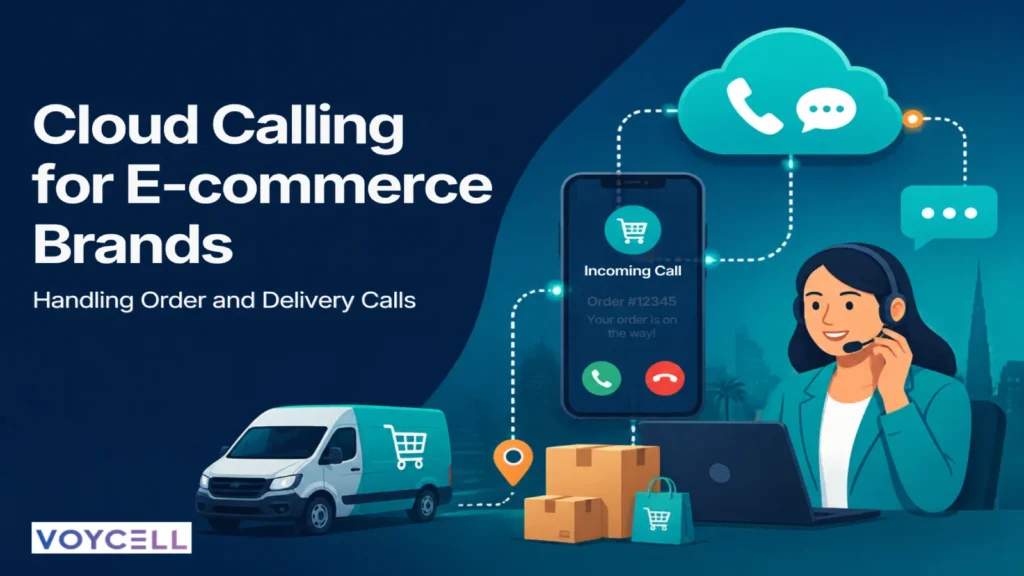
Cloud calling helps e-commerce brands answer order and delivery calls faster. It routes each caller to the right agent and links the call to the customer’s order. Unlike a single office line, it works from any device and scales with demand.
Most calls to an online store are simple. Customers want to know where an order is, change an address or start a return. Cloud calling handles these calls with menus, smart routing and CRM links. Agents then spend their time on problems that need a person.
This guide covers the common call types, the features that matter and how to prepare for peak season. It also shows how to set up your call flow step by step.
Why E-commerce Brands Get So Many Order and Delivery Calls
Online shoppers cannot see or touch what they buy. That gap creates questions before and after every order.
Delivery is the biggest source of calls. Customers want updates, and they call when a courier is late or cannot find the address. In the UAE, couriers also phone customers to confirm locations and delivery windows. Cash on delivery orders add confirmation and rescheduling calls.
Promotions raise call volume too. A sale, a product launch or a delayed shipment can multiply calls within hours.
A single phone line cannot cope with this. Callers hear a busy tone or wait on hold, and many give up. Some then cancel the order or leave a bad review.
Common E-commerce Call Types and How Cloud Calling Handles Them
These are the calls most online stores take every day. Each one needs a different team or a different answer.
Call type | What the customer asks | How cloud calling helps |
|---|---|---|
Order status | Where is my order? | A menu option routes the call, and the CRM shows the order when the agent answers |
Delivery delay | The courier is late | Delayed orders go to a priority queue, with a callback offered instead of a long wait |
Address or time change | Can I update my delivery details? | Routing sends the call straight to the dispatch team |
Failed delivery | I missed the courier | A missed call is logged, and an agent calls back during working hours |
Returns and refunds | How do I return this? | Calls go to the returns team, and recordings keep a clear record |
Payment issues | Why was I charged twice? | Routing sends the call to billing, and recordings help resolve disputes |
Pre-sale questions | Is this in stock? | Calls go to sales, and an instant callback captures the lead |
Cloud Calling Features E-commerce Teams Need
Not every feature matters for an online store. These are the ones that make the biggest difference to order and delivery calls.
- IVR menus: Callers press a number for order status, returns or billing. This cuts the time agents spend sorting calls.
- Smart routing: Rules send each call to the right team by topic, language or time of day. Arabic and English speakers reach the right agent.
- CRM and order data on screen: When the system links to your CRM, agents see the customer and order details as the call connects. Customers no longer repeat their order number.
- Callbacks: A callback option replaces long waits. Agents return the call when the queue clears.
- Call recording: Recordings support training, quality checks and refund or delivery disputes.
- Live monitoring: Managers watch queues in real time and step in during busy periods.
- Virtual numbers: A local business number builds trust. You can add separate numbers for sales, support and delivery.
- Voice, SMS and chat in one inbox: Customers who message first can switch to a call without starting over.
How to Handle Call Spikes in Peak Season
Peak sales hit UAE brands several times a year. White Friday, Ramadan and Eid offers, and the Dubai Shopping Festival all bring more orders. More orders mean more delivery calls a few days later.
Plan for the spike before it starts:
- Add capacity early: Cloud systems let you add agents and lines without new hardware. Set this up before the sale begins.
- Use an overflow route: When all agents are busy, send extra calls to a second team, a callback queue or a virtual agent.
- Update your menu: Put the most common request first, such as order status. Keep the menu short.
- Announce delays: If couriers are late, record a short message at the start of the call. Many callers get their answer and hang up.
- Watch the queue: Check wait times and abandoned calls every hour. Move agents to where callers are waiting.
- Plan for the tail: Delivery calls peak a few days after the sale, not on the sale day.
How to Set Up Your E-commerce Call Flow in 8 Steps
- List your call types. Review last month’s calls and group them by reason, such as order status, returns and billing.
- Assign each type to a team. Decide who handles delivery, returns, billing and sales questions.
- Build your phone menu. Use four or five options at most, with the most common request first.
- Set routing rules. Route by topic, language and time of day. Add an overflow route and a callback option.
- Connect your CRM or order system. Agents should see the customer and order details when the call connects.
- Turn on call recording. Set a weekly review of a few calls per agent for quality.
- Prepare your agents. Give them short scripts for delays, failed deliveries and refund requests.
- Test, launch and review. Make test calls for every menu option. After launch, review the results every week.
Metrics to Track for Order and Delivery Calls
Track these seven numbers every week. They show where customers get stuck and where your team needs help.
Metric | What it tells you | If it is poor |
|---|---|---|
Average wait time | How long callers wait before an agent answers | Add agents or an overflow route |
Abandoned call rate | How many callers hang up before they are answered | Offer callbacks and shorten the menu |
First call resolution | How often one call solves the problem | Give agents order data and clearer scripts |
Average handle time | How long each call takes | Check for missing order details on screen |
Callback completion rate | How many requested callbacks end in a conversation | Set callback targets and review missed ones |
Calls per 100 orders | How many orders lead to a call | Fix the delivery updates that cause repeat calls |
Post-call satisfaction | How customers rate the support they got | Review recordings of low-rated calls |
Calls per 100 orders is the most useful number for an online store. If it rises, something in delivery or communication has gone wrong.
How Voycell Helps UAE E-commerce Brands
Voycell is a UAE-based cloud calling platform for growing businesses. It gives online stores the tools in this guide in one place.
- Business numbers, IVR menus and smart routing for order and delivery calls
- Integrations with 100+ CRM and business platforms, so order details show on screen
- Call recording and live monitoring for quality checks and disputes
- Virtual call agents for after-hours calls and overflow
- Voice, SMS and chat in one inbox
Ready to cut wait times and missed delivery calls? Book a demo with Voycell and see a call flow built for your store.
Frequently Asked Questions
What is cloud calling for e-commerce brands?
Cloud calling is a phone system that runs over the internet instead of a physical line. For online stores, it routes order and delivery calls to the right agent. It also links each call to the customer’s order.
How does cloud calling help with order and delivery calls?
Menus and routing send each call to the right team quickly. Callbacks replace long waits, and CRM links show order details on screen. Agents solve more problems in a single call.
Can cloud calling handle peak season call spikes?
Yes. Cloud systems let you add agents and lines without new hardware. Overflow routes and callbacks keep callers from hitting a busy tone during sales like White Friday.
Can customers get order status without speaking to an agent?
Yes, if your system links to your order data. A menu or virtual agent can answer common questions, and agents take the rest. Check which options your provider supports.
Does cloud calling work with my CRM or e-commerce platform?
Most cloud calling platforms connect to popular CRMs through built-in integrations or APIs. Voycell integrates with 100+ CRM and business platforms. Ask your provider whether yours is supported before you sign up.
Can my support team work from home or several locations?
Yes. Cloud calling works on a laptop or mobile app from any location with a stable internet connection. This suits support teams that work remotely or across several offices.
How much does cloud calling cost for an online store?
Pricing usually depends on the number of agents, call volume and features. Most providers charge per user per month, with extra costs for numbers and call minutes. Ask for a written quote based on your expected call volume.
How do I know if my current phone setup is failing?
Watch for busy tones, long hold times and customers repeating their order number. A rising number of calls per order is another warning sign. If agents cannot see order details during calls, it is time to upgrade.


