
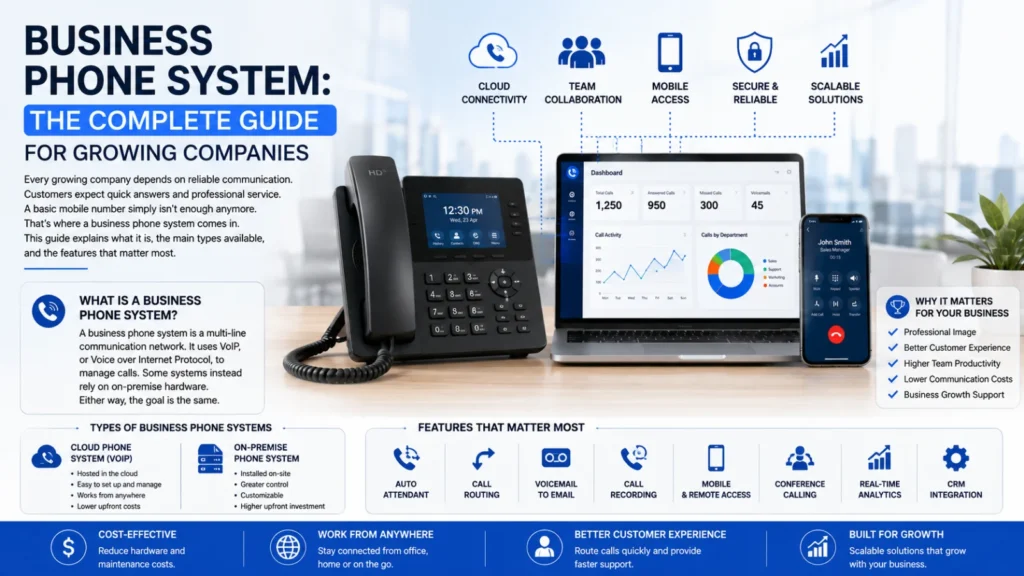
Every growing company depends on reliable communication. Customers expect quick answers and professional service. A basic mobile number simply isn’t enough anymore. That’s where a business phone system comes in. This guide explains what it is, the main types available, and the features that matter most.
What Is a Business Phone System?
A business phone system is a multi-line communication network. It uses VoIP, or Voice over Internet Protocol, to manage calls. Some systems instead rely on on-premise hardware. Either way, the goal is the same. Multiple employees can make and receive calls professionally. Callers reach the right person or department quickly. Businesses no longer need one phone line per desk. Instead, calls route intelligently across teams and locations.
Key Types of Business Phone Systems
Choosing the right system starts with understanding your options. There are three main types businesses typically choose from.
1. Cloud or Hosted VoIP
Cloud VoIP systems run entirely over the internet. There’s no need for bulky on-site equipment. Upfront costs are low compared to traditional systems. Most providers offer mobile and desktop app integration. Employees can answer business calls from anywhere. This makes cloud VoIP ideal for remote and hybrid teams. It’s also the fastest option to set up and scale.
2. On-Premise IP PBX
On-premise IP PBX systems use local hardware. This hardware connects to local providers, such as Etisalat or du. Calls are managed through equipment installed at your office. This option offers strong control over your infrastructure. However, it usually requires higher upfront investment. Maintenance and upgrades often need dedicated IT support. It suits larger companies with specific compliance or control needs.
3. Hybrid Systems
Hybrid systems combine both worlds effectively. Physical desk phones connect alongside remote cloud extensions. Office staff keep their familiar desk phone setup. Remote employees still join the same phone system easily. This flexibility makes hybrid systems popular with growing teams. Companies expanding into new locations often prefer this approach.
Essential Features to Look For
Not all business phone systems offer the same capabilities. Here are the features that matter most.
Auto-Attendant and IVR
An auto-attendant greets callers automatically, day or night. Interactive Voice Response, or IVR, routes callers using menus. For example, callers might hear “Press 1 for sales.” This ensures every call reaches the correct department. It also creates a more professional first impression. Small teams can sound like a large, organized company.
Call Management
Strong call management tools keep conversations flowing smoothly. This includes call forwarding, holding, and warm transfers. Multi-way conferencing lets several people join one call. Warm transfers let agents introduce callers before handing off. This reduces repeated explanations and frustrated customers. Well-managed calls lead to faster resolutions overall.
Voicemail to Email
Voicemail-to-email converts recorded messages into text or audio files. These files are then sent straight to your inbox. Employees no longer need to dial in for voicemail. They can review messages instantly from their email client. This speeds up response times significantly. It also creates a searchable record of missed calls.
CRM Integrations
CRM integrations sync call logs with your existing software. Popular platforms include Salesforce and Microsoft Teams. Every call, including duration and outcome, gets logged automatically. Sales and support teams gain valuable context instantly. This eliminates manual data entry after every call. It also helps managers track team performance accurately.
Why These Features Matter Together
Individually, each feature offers clear value. Combined, they transform how a business communicates. Auto-attendants save time for both callers and staff. Call management tools reduce friction during conversations. Voicemail-to-email keeps nothing from falling through the cracks. CRM integration turns calls into usable business data. Together, they create a seamless communication experience for everyone involved.
Cloud VoIP vs. On-Premise: Which Should You Choose?
The right choice depends on your business needs. Startups and remote teams often prefer cloud VoIP systems. Lower costs and fast setup make it attractive. Established companies with strict data control needs may prefer on-premise systems. Hybrid systems offer a practical middle ground for many. They support office staff and remote employees equally well. Consider your budget, team size, and growth plans carefully.
Industries That Benefit Most
Sales Teams
Sales teams rely on call volume and speed. Power dialers and CRM integration boost productivity significantly. Every call gets logged for follow-up automatically.
Customer Support
Support teams need quick, accurate call routing. IVR menus direct customers to the right agent instantly. Call recording also helps with training and quality checks.
Real Estate and Property Management
Agents juggle constant calls from buyers and tenants. Voicemail-to-email ensures no inquiry gets missed. CRM syncing keeps client details organized automatically.
Logistics and Cargo Companies
Logistics teams manage urgent, time-sensitive calls daily. Multi-line systems prevent missed calls during peak hours. Call transfers connect customers to the right department fast.
How to Choose the Right Provider
Selecting a provider requires careful comparison. Consider these factors before making a decision.
- Call quality. Ask about uptime guarantees and network reliability.
- Scalability. Confirm the system can grow with your team.
- Integration support. Check compatibility with your CRM and helpdesk tools.
- Local compliance. Ensure the provider is licensed to operate in your region.
- Customer support. Look for responsive, accessible support when issues arise.
- Pricing structure. Avoid providers with hidden fees or rigid contracts.
Request a demo before committing to any provider. This lets you test call quality and features firsthand. Compare a few options rather than choosing the first one.
Getting Started with a Business Phone System
Switching systems doesn’t have to disrupt daily operations. Most providers support number porting to keep your existing number. Setup can often be completed within a few days. Training staff usually takes just one short session. Many businesses notice smoother call handling almost immediately.
If your company still relies on outdated phone lines, now is the time to upgrade. VOYCELL can help you find the right business phone system. Reach out today to explore a solution built for your needs.
Frequently Asked Questions
What is a business phone system?
It’s a multi-line communication network using VoIP or on-premise hardware. It helps businesses manage calls professionally across teams.
What’s the difference between cloud VoIP and on-premise IP PBX?
Cloud VoIP runs over the internet with low upfront costs. On-premise IP PBX uses local hardware connected to local providers.
What is a hybrid phone system?
It combines physical desk phones with remote cloud extensions. This supports both office staff and remote employees together.
What does auto-attendant or IVR do?
It greets callers automatically and routes them using menus. For example, “Press 1 for sales” directs calls instantly.
What is voicemail-to-email?
It converts voice messages into text or audio files. These files are sent directly to your email inbox.
Can a business phone system integrate with my CRM?
Yes. Most systems sync call logs with platforms like Salesforce or Microsoft Teams automatically.
Is cloud VoIP reliable for daily business use?
Yes. Reputable providers offer strong uptime guarantees and clear call quality. Automatic failover also helps during outages.
How long does it take to set up a new system?
Most cloud VoIP systems can be set up within a few days. On-premise systems may take longer due to hardware installation.
Can I keep my existing business number?
In most cases, yes. Providers typically support porting your existing number over.
Is a business phone system suitable for small businesses?
Yes. Cloud VoIP options are often affordable and flexible. This makes them ideal for small and growing teams.


